Receive
email notices from this page with FeedBlitz
Return to Tools for the Teacher Return to Computers for Education HOME
Read/Write/Think
Other Poetry Types
Sharing Poetry
Sites to Read and Hear Poetry
Extensive Lesson Plan for Teaching Poetry
QUICKSTEPS

to
teaching
Poetry
Poetry Sites
The very most effective book I have used to teach poetry is Wishes, Lies, and Dreams, by Kenneth Koch (available at Amazon.com and elsewhere). The following is a slideshow that demonstrates most of the different kinds of poetry Koch describes: Teaching Poetry. |
At Poetry Tools, you can create an instant poem online, view lesson plans, and download tools for making poetry. The metaphor tool opens as a Flash window, for example. Here is a comment from a student about using Poetry Tools:
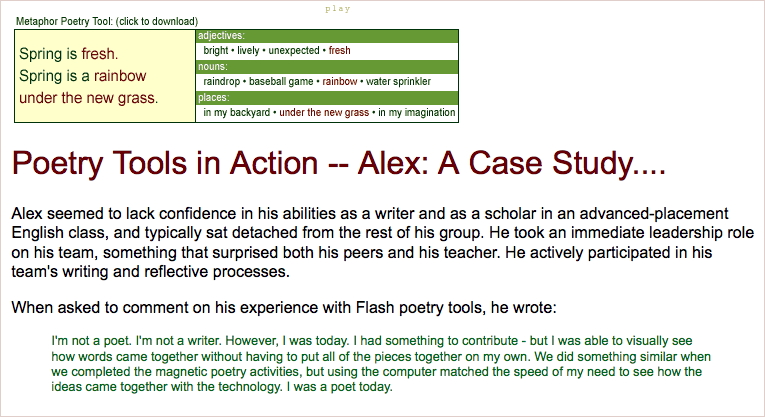
One of the best ways to do poetry writing, especially in the beginning, is in small groups--e.g., in a group of five, each person could add one line--or in pairs. I found that my ESL and EFL students wound up writing even more poems in their journals/portfolios, just for the sheer pleasure of it.
Read/Write/Think . . .
Poetry
The Read//Write/Think
site (sponsored by IRA and NCTE) is oriented to native
English speakers, but has some great tools for writing
poetry online. Their Flash-based activities are informative
about poems and metaphoric language as well as helping
students instantly create interesting poems online. Two of
these targeted for grades 6-12 (that is, adult learners
generally) are Acrostic
Poems use the letters in a
word to begin each line of the poem. All lines of the
poem relate to or describe the main topic word. Students
are prompted to brainstorm, write, and revise their
poems, thus reinforcing elements of the writing process.
(Flash required; printable.)
Diamante Poems (see also cinquain poems below) use nouns, adjectives, and gerunds to describe a central topic or two opposing topics (for example, night/day or winter/spring). The tool has numerous word study applications and reinforces the connection between word study (parts of speech) and the writing process. (Flash required; printable.)
Shape Poems (especially for younger students) describe an object and are written in the shape of the object. In this online tool, students are prompted to brainstorm, write, and revise their poems, thus reinforcing elements of the writing process. Students can also print their finished shape poems and you can encourage them to devise their own shapes and themes.
Diamante Poems (see also cinquain poems below) use nouns, adjectives, and gerunds to describe a central topic or two opposing topics (for example, night/day or winter/spring). The tool has numerous word study applications and reinforces the connection between word study (parts of speech) and the writing process. (Flash required; printable.)
Shape Poems (especially for younger students) describe an object and are written in the shape of the object. In this online tool, students are prompted to brainstorm, write, and revise their poems, thus reinforcing elements of the writing process. Students can also print their finished shape poems and you can encourage them to devise their own shapes and themes.
Other Poetry Types
Cinquain
One other type of poem I have often used is the cinquain (5 lines): Each line uses a different sense. I usually start with a color:YELLOW
...sounds like horns blaring
...looks like a brilliant sunny day
...feels like a fuzzy dandelion leaf
...smells like citrus iced tea
...tastes like lemon drops
...sounds like horns blaring
...looks like a brilliant sunny day
...feels like a fuzzy dandelion leaf
...smells like citrus iced tea
...tastes like lemon drops
You can have students fill in the words after "like" as a group in the class. Then they can do their own poem with a different color. Then ask them to write one more, but remove the "sounds like," etc. stems. It makes for "real" poetry, that is, it turns the similes into metaphors. Again, once students understand how metaphors work, they can start to recognize and incorporate them into other types of writing.
You can break down each poem in the slideshow and see how it is structured; then have students write one together as a whole class and eventually make their own poems individually.
Haiku
After they have done some of the poems demonstrated in the slideshow, I also would have them try haiku in an English version: 5 words in the first line, 7 words in the second, and 5 words in the last. The lines must include a place, a time, a plant or tree that symbolizes a season, a color, and a feeling/emotion (all of these may be implied). The last line must make a contrast:SPRING
Cold rain whipping morning branches
Slick grey sidewalks, umbrellas fast against rain
Dogwoods blooming pink and white
A similar, downloadable Haiku
Pattern Template (PDF file) may be found at Read/Write/Think.org.
For the complete lesson plan, see Reading, Writing, Haiku
Hiking! A Class Book of Picturesque Poems
for grades 3-5 (ages 8-11).
Used to be.../But now...
As Koch points out, students really like the I used to be.../But now I am.../ type of poem, as everyone feels the sense of change and continuity that makes up their own personality. I had students write this poem using a different animal for each line, with accompanying adjectives, colors, etc.:I used to be . . .
. . . stubborn as a mule, bookish and grey as an
owl,
But now I am . . .
. . . patient as an ant, lively and
red as a robin.
Discussion of the appropriateness of different animals, and their meanings in different cultures can be quite interesting. You can also use the used to be/but now format with diamante poems, or haiku. You can also make up your own rules for poems, e.g., a sestina with six stanzas of six lines each using the different senses, one to each line (and the "sixth sense"). Blending and mixing the different formats will start to feel natural, and students will spontaneously come up with their own.
For a very complete set of lessons in teaching poetry, see Creating Classroom Community by Crafting Themed Poetry Collections at the Read/Write/Think site.
Sharing poetry
Poetry from its very beginnings has been a communal
endeavor. ("Homer" was probably a collection of the work of
numerous bards over the centuries.) And poetry has been
almost exclusively oral up until just a few centuries ago.
Students love to read their poems to each other--and they
like making poems about each other, as in the acronym poem
illustrated in the slideshow. Publishing online, preferably
with a podcast reading, is also a good project that would
use technology skills, drawing, digital images or video,
audio/speaking, etc., as well as creative writing. Or use VoiceThread to have
students speak, illustrate, and comment on each other's
poems. Please have students put their poem productions on a
blog or wiki or podcast, or "publish" them online in some
way--and I would love to see how their efforts turn out. My
students have always loved the poetry writing section of a
creative writing course the best.Sites to Read and Hear Poetry
PoetryEd: An Online Resource for Teaching International Poetry - An online resource for classroom teachers teaching international poetry. Language Arts standards in poetry (preK-8).
Lit2Go - a free online collection of stories and poems in mp3 to listen to online or download. Read as you listen; print your own book of favorites.
Extensive Lesson Plan for Teaching Poetry
"Hurrah for Poetry!" by Sara Sahr, TESOL
Connections, April 2013
«««««««««««««««««««««««««««««
Please see also Quicksteps to Writing a Short Story when you are ready to move to short stories. What students have learned about metaphor should now carry over into prose.
If you are aware of other good resouces for
teaching poetry, please write to me at ehansonsmi
at yahoo.com
Dr. Elizabeth Hanson-Smith
Teacher Educator, Online Consultant