Read: Start of Section 3.1.
Turn in: 2.72(d,e,g), 2.73, 3.3
- A reminder for 2.72: you first need to draw a vertex for each element of your group, and to do this, you need to choose a way to represent the elements. For \(D_3 = \langle r,s\rangle\), you will probably choose \(D_3 = \{e,r,r^2,s,sr,sr^2\}\) or \(D_3 = \{e,r,r^2,s,rs,r^2s\}\) (keeping in mind that \(sr = r^2s\) and \(sr^2 = rs\)), and for \(D_3 = \langle s,s'\rangle\), you will probably choose \(D_3 = \{e,s,s',ss',s's,ss's\}\) or \(D_3 = \{e,s,s',ss',s's,s'ss'\}\) (since \(ss's = s'ss'\)).
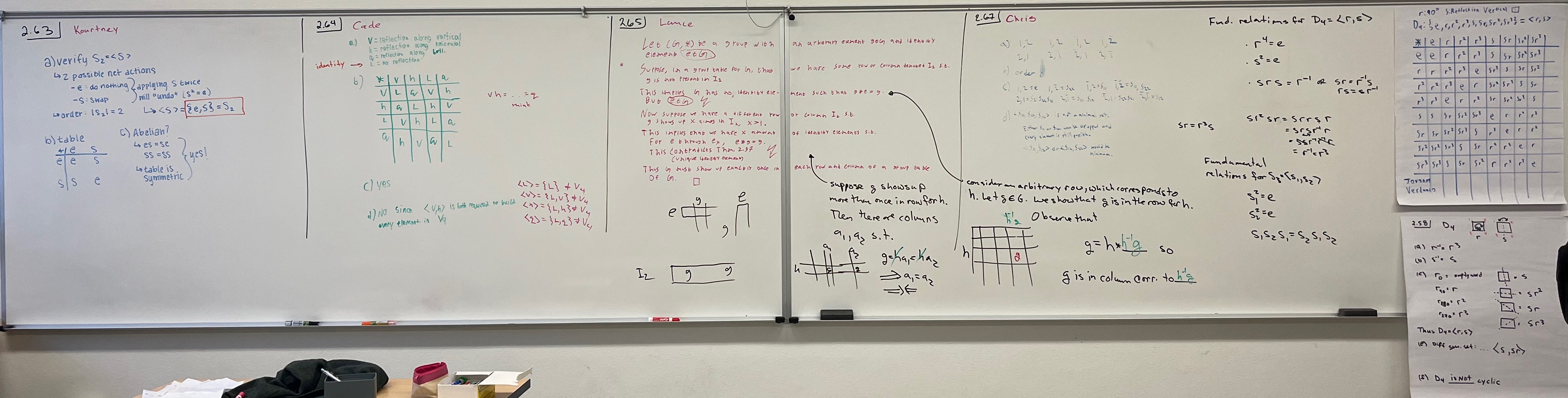
- I recommend making your choice based on how the elements were labeled when you made your group table in the previous section, and remember that the book provides a group table for \(D_3\) on page 28. Also, here’s a picture of Jovanny’s Group Table for \(D_4\).
Then you need to draw an arrow coming out of each vertex for each element of the generating set. When you do this, remember that the arrow corresponds to “multiplying” the vertex element on the left by the element corresponding to the arrow. For example, when working with \(D_3 = \langle r,s\rangle\) you will have six vertices and one of the vertices will be labeled \(s\). Then, you should draw an \(r\)-arrow going from the vertex \(s\) to the vertex \(rs\), and you should draw an \(s\)-arrow going from the vertex \(s\) to the vertex \(ss = e\). Now repeat this for the other 5 vertices. The group tables from before should help with this. Note that the Cayley diagram for \(D_3 = \langle r,s\rangle\) is actually drawn in the book a couple of pages later, so you can use that to check your work.
- For 2.73, you can just draw the portion of the Cayley diagram that includes the vertices from $-6$ to $6$.
Extra practice: 2.74–2.82