Class times: Mon + Wed + Fri from 09:00–09:50 AM [Alpine 212]
Book: An Inquiry-Based Approach to Abstract Algebra by D.C. Ernst (the book is free and open source)
Syllabus: Syllabus for Math 110A
Instructor: Dr. Joshua Wiscons (he/him)
Email: joshua.wiscons@csus.edu
Office: Brighton Hall (BRH) Room 144
Student office hours:
- In person: Monday 2–3 PM and Wednesday 2–3 PM [Brighton 144]
- Virtual: Thursday 1–2 PM [only via Zoom]
- Also by appointment. Just send me an email.
Teaching Assistant: Emma Breck (she/her)
Email: erbreck@csus.edu
Office hours: Tuesday from 3:00–4:30 PM [Brighton 118]
Daily Homework
Writing Assignments
Course Log
[05.15.26] - Friday
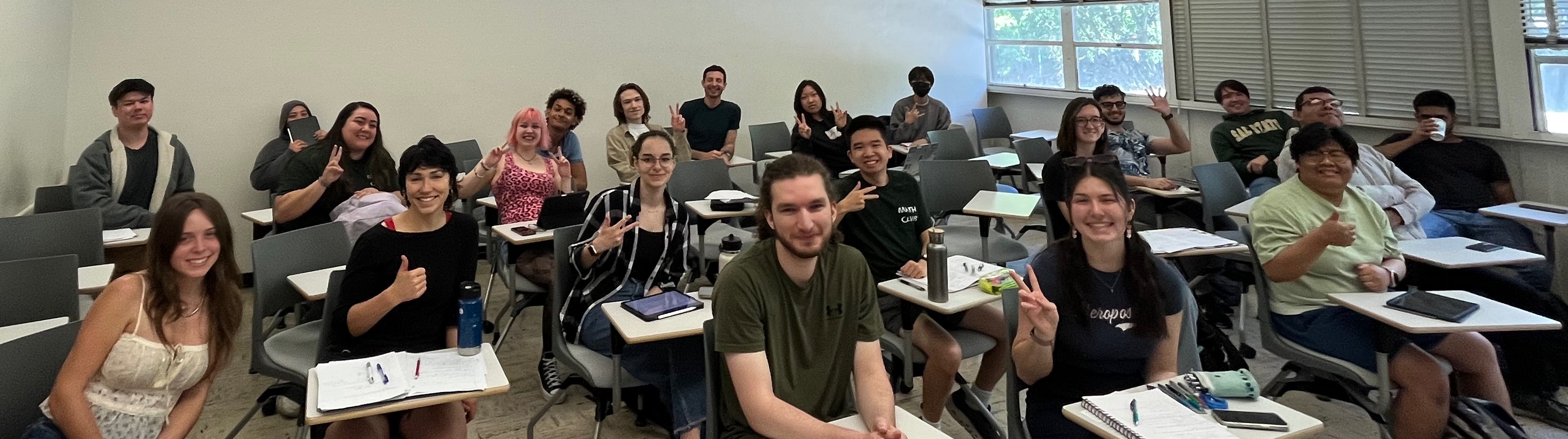
| What we covered: Last class! Finished up the remaining problems on the First Isomorphism Theorem and talked a bit about the final. Thanks for a great semester you all! Good luck prepping for the final! |
 |
[05.13.26] - Wednesday
| What we covered: We began by discussing the First Isomorphism Theorem and seeing how it can be viewed as taking a homomorphism of groups and turning it into an isomorphism. We then worked out the possible homomorphisms from \(\mathbb{Z}_3\) to \(\mathbb{Z}_6\). We finished the day using the First Isomorphism Theorem to show \(Q_8/\langle -1\rangle \cong V_4\). We had three more problems on the board, and we’ll talk through them next time. |
| Due next class meeting: Nothing. Just start reviewing for the final and bring questions. |
[05.11.26] - Monday
| What we covered: Continued with homomorphisms and kernels today. |
| Due next class meeting: HW39. |
Week 14
[05.08.26] - Friday
| What we covered: Started on homomorphisms with proofs about images, kernels, and the order of the image of an element. More next time. |
| Due next class meeting: HW38. |
[05.06.26] - Wednesday
| What we covered: Did a lot of work with quotients today. We worked through a handful of examples and also a couple of proofs. We also did a first problem on homomorphisms. Homomorphisms will be our last main topic for this semester, but the big result we are working towards will bring us back to quotient groups. |
| Due next class meeting: HW37. |
[05.04.26] - Monday
| What we covered: Back to regular class today. Got several problems on the board, but only made it through a couple about direct products. Next time we’ll get to work with quotients. |
| Due next class meeting: HW36. |
Week 13
[05.01.26] - Friday
| Exam day |
| Due next class meeting: HW35. |
[04.29.26] - Wednesday
| What we covered: Lectured a little more on quotient groups and then talked a bit about Friday’s exam. |
| Due next class meeting: nothing; just prep for the exam. |
[04.27.26] - Monday
| What we covered: We began with a problem from last time about the maximal order of elements in direct products of groups. After that I lectured a little on the Fundamental Theorem of Finite Abelian Groups and then transitioned to the beginnings of quotient groups. I’ll spend a little more time discussing quotient groups on Wednesday and then we can review for Friday’s exam. |
| Due next class meeting: continue with HW34. |
Week 12
[04.24.26] - Friday
| What we covered: Started with a couple older problems: one related to Lagrange and the other about checking if a subgroup is normal. We then moved to direct products of groups. In the first first few examples, we saw that \(\mathbb{Z}_2 \times \mathbb{Z}_3\) cyclic (so isomorphic to \(\mathbb{Z}_6\)) and \(\mathbb{Z}_2 \times \mathbb{Z}_2 \cong V_4\), but \(\mathbb{Z}_4 \times \mathbb{Z}_2\) is a group we hadn’t met yet. We also started computing orders of elements in direct products. |
| Due next class meeting: Please look over and try HW34 (focus on reading the beginning of Section 6.2), but you will not turn it in. Instead, I will discuss the problems during the next class. Try to use the extra time to start preparing for the exam. |
[04.22.26] - Wednesday
| What we covered: Got a lot on the board today, but we were only able to talk through a couple of problems about normal subgroups. One problem showed that $\langle(1,2,3)\rangle$ is not a normal subgroup of \(A_4\), and the other illustrated the utility of the theorem that subgroups of index 2 are normal (while also showing that normality is not a transitive relation). We’ll cover the remaining problems next time. |
| Due next class meeting: HW33. |
[04.20.26] - Monday
| What we covered: Started off discussing Lagrange’s theorem and the intuition behind it. We then worked through various examples and applications, culminating with a proof that every group of order $p$ is isomorphic to \(\mathbb{Z}_p\). |
| Due next class meeting: HW32. |
Week 11
[04.17.26] - Friday
| What we covered: Worked through more examples of cosets today and then proved two results related to some observations we’ve made: (1) for $H$ a subgroup of $G$, the relation \(a\sim b \iff a^{-1}b \in H\) defines an equivalence relation on $G$ (as does $a\sim b \iff ab^{-1} \in H$), and (2) all cosets of a given subgroup have the same size. Hope folks enjoy the weekend! |
| Due next class meeting: HW31. |
[04.15.26] - Wednesday
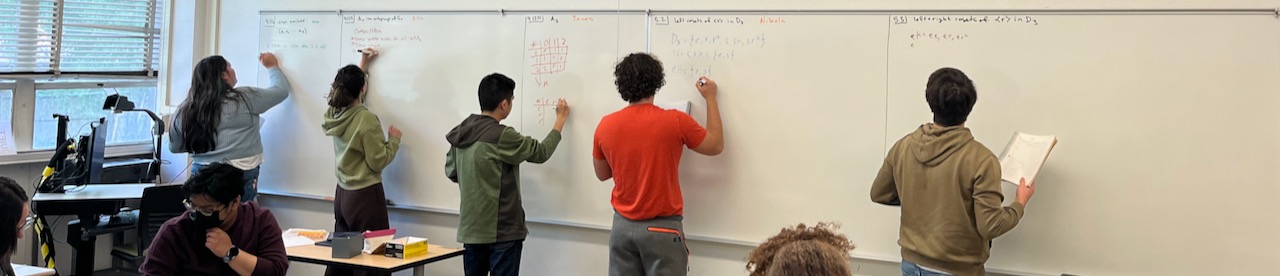
| What we covered: Finished up our work with permutations by looking a bit more at alternating groups and then got started on cosets. |
 |
| Due next class meeting: HW30. |
[04.13.26] - Monday
| What we covered: Continued working with permutations and looked at how we can break them down into a product of transpositions. This led to the notion of even and odd permutations (which will in turn lead to the definition of the alternating group next time). |
| Due next class meeting: HW29. |
Week 10
[04.08.26] - Friday
| What we covered: Lots more with cycle notation today and then ended with the Cayley diagram for \(S_3\) with respect to the generators $(12)$ and $(123)$, which showed us that \(S_3\) and \(D_3\) are isomorphic. Happy Friday everyone! |
| Due next class meeting: HW28. |
[04.06.26] - Wednesday
| What we covered: Took a closer look at \(S_n\) and spent some time understanding how to write, think, and compute with cycle notation. |
| Due next class meeting: HW27. |
[04.06.26] - Monday
| What we covered: Wrapped up cyclic groups today with some results about computing orders of elements. Then we got started on permutations and the groups \(S_n\), thinking about them as functions and also representing them with string diagrams. Next time we’ll see another way to represent them using cycle notation. |
| Due next class meeting: HW26. |
Week 9
[04.03.26] - Friday
| What we covered: Explored \(U_{12}\), and then looked at some problems related to the important fact that every subgroup of a cyclic group is also cyclic. We finished by cicling back to a problem from last time proving that every cyclic group of order $n$ with $n\ge 3$ is isomorphic to \(R_n\). Another great day–thanks!! |
| Due next class meeting: HW25. |
[04.01.26] - Wednesday
| What we covered: Continued with cyclic groups, starting with an important result about the order of elements: $g^k=e$ if and only if $|g|$ divides $k$. Next we had a very (perhaps the most) important result about cyclic groups, which is that we know them all: a cyclic group is isomorphic to either the trivial group, \(S_2\), \(R_n\) (with $n\ge 3$), or $\mathbb{Z}$. After that, we met some new groups \(\mathbb{Z}_n\) and \(U_n\) using arithmetic modulo $n$ and worked out the details of \(\mathbb{Z}_4\) and \(U_{10}\), ultimately seeing that both are isomorphic to \(R_4\). |
| Due next class meeting: HW24. |
[03.30.26] - Monday
| What we covered: Back from spring break! Continued with cyclic groups focusing on some important theorems about orders of elements. |
| Due next class meeting: HW23. |
Week 8
[03.20.26] - Friday
| What we covered: Continued with cyclic groups. Saw many examples of cyclic subgroups of our favorite groups and computed orders of elements. We also saw that \((\mathbb{R},+)\) is not cyclic. And then we had a couple of important theoretical results: cyclic groups are abelian, and a group without proper nontrivial subgroups is necessarily cyclic. Fun day! Happy spring break you all!! |
| Due next class meeting: HW22. |
[03.18.26] - Wednesday
| What we covered: Wrapped up isomorphisms today with a couple of longer proofs. The first showed that if we have an isomorphism from \(G_1\) to \(G_2\) and \(G_1\) is abelian, then so is \(G_2\) (and we also observed this remains true just assuming we have a surjective homomorphism). The second showed that the image of a subgroup under an isomorphism is also a subgroup. We then got started taking a closer look at cyclic groups (and subgroups). |
| Due next class meeting: HW21. |
[03.16.26] - Monday
| What we covered: Exam done—back to regular class! We revisited isomorphisms and first looked at some more examples and nonexamples. We then had a couple of theorems: isomorphisms map inverses to inverses, and the composition of isomorphisms is again an isomorphism. Finished by working with group tables to see that every group of order 4 is isomorphic to either \(R_4\) or \(V_4\). |
| Due next class meeting: HW20. |
Week 7
[03.13.26] - Friday
| Exam day |
| Due next class meeting: HW19 |
[03.11.26] - Wednesday
| What we covered: Lectured a little more on isomorphisms today and then talked about Friday’s exam. |
| Due next class meeting: nothing; just prep for the exam. |
[03.09.26] - Monday
| What we covered: Lectured today on isomorphisms. We spent some time talking through and dissecting the definition and then worked to show that \((\mathbb{R},+) \cong (\mathbb{R},\cdot)\) via the exponential map and \((\mathbb{Z},+) \cong (2\mathbb{Z},+)\) via the multiplication-by-2 map. We’ll continue with isomorphisms on Wednesday and also spend some time reviewing for Friday’s exam. |
| Due next class meeting: continue with HW18. |
Week 6
[03.05.26] - Friday
| What we covered: Working towards the notion of isomorphism, we looked at matchings of Cayley diagrams as well the idea of “identical table colorings” today. We started by seeing a (very nonobvious) matching between \(D_4 = \langle r, s \rangle\) and \(\operatorname{Spin}_{1\times 2}\) by using the generating set \(\{s_{22}s_{12}, s_{11}\}\) for \(\operatorname{Spin}_{1\times 2}\). Our next two problems introduced the “lightswitch groups” \(L_2\) and \(L_3\). We saw that \(L_2\) and \(V_4\) can be matched, but \(L_3\) is honestly different than any group we’ve met so far. We finished by seeing that \(V_4\) and \(L_2\) have an identical table coloring. Great day—thanks! |
| Due next class meeting: Please look over and try HW18 (and also record questions that you have), but you will not turn it in. Instead, I will discuss the problems during the next class. Try to use the extra time to start preparing for the exam. |
[03.04.26] - Wednesday
| What we covered: Continued with subgroup lattices today. We began by building the one for \(D_4\) together and making some observations about streamlining the process. Then we got to see the lattices for \(S_3\) and \(Q_8\). On to matchings (as a precursor to isomorphisms) next time. |
| Due next class meeting: HW17. |
[03.02.26] - Monday
| What we covered: Finished up some problems from last time, and then started with subgroup lattices by building the one for \(R_4\) and starting on the one for \(D_4\). More lattices next time. |
| Due next class meeting: HW16. |
Week 5
[02.27.26] - Friday
| What we covered: The focus of the day was on the center of a group. We proved that \(Z(G)\) is always a subgroup of \(G\) and computed the center of the groups: \(V_4\), \(D_3\), and \(D_4\). We have a couple of problems to finish up next time, and then we’ll get started on subgroup lattices. |
| Due next class meeting: HW15. |
[02.25.26] - Wednesday
| What we covered: Continued with subgroups today. Saw several examples and nonexamples in \((\mathbb{R}^3,+)\), \((\mathbb{Z},+)\), and \((D_8,\circ)\). More next time! |
| Due next class meeting: HW14. |
[02.23.26] - Monday
| What we covered: Got started on subgroups today. We began with a general result, and then looked for subgroups inside of \(\operatorname{Spin}_{1\times 2}\) and \(D_4\). The last problem introduced us to the groups \(Q_8\) and looked at some of its subgroups too. |
| Due next class meeting: HW13. |
Week 4
[02.20.26] - Friday
| What we covered: More Cayley diagrams: today we saw ones for \(D_3 = \langle r,s\rangle\), \(D_3 = \langle s,s'\rangle\), and \(D_4 = \langle r,s\rangle\) as well as a few for \(\mathbb{Z}\) with respect to some different generating sets. We also got started on subgroups by looking at how \(R_4\) sits inside \(D_4\). Happy weekend you all! |
| Due next class meeting: HW12. |
[02.18.26] - Wednesday
| What we covered: Cayley diagrams today! We investigated the diagrams for \(\operatorname{Spin}_{1\times 2} = \langle s_{11}, s_{12}, s_{22} \rangle\), \(R_6 = \langle r \rangle\), \(R_4 = \langle r \rangle\), and \(V_4 = \langle v,h \rangle\), and in the first two cases, we used them to answer questions about the group. We’ll look at a few more diagrams next time, and then get started on the next chapter. |
| Due next class meeting: HW11. |
[02.16.26] - Monday
| What we covered: Lot’s more group tables today: \(D_4\), \(S_3\), \(S_2\), \(V_4\). As we talked through them, we also started to take note of the key relations in some of these groups. For example, in \(R_4\) the main relation is just that \(r^4 = e\); whereas in \(D_4\), we have \(r^4 = e\) and \(s^2 = e\) together with \(srs = r^{-1}\) describing the interaction of the two generators. In \(S_3\), we have \(s_1^2 = e\), \(s_2^2 = e\) and \(s_1s_2s_1 = s_2s_1s_2\). We also worked through a proof that each element of a group appears exactly once in each row and each column in any group table for the group. Great day! |
| Due next class meeting: HW10. |
Week 3
[02.13.26] - Friday
| What we covered: Continued with generating sets today, and saw \(D_3 = \langle s, s' \rangle\), \(S_3 = \langle s_1, s_2 \rangle\), and \(\mathbb{Z} = \langle 1 \rangle = \langle -1 \rangle\) (the last of which generated—pun intended—a good discussion on the subtleties of how we generate groups). We finished by constructing the group table of \(R_4\). Didn’t get to everything today, so we’ll start with the tables for \(D_4\) and \(S_3\) on Monday. Happy weekend |
| Due next class meeting: HW09. |
[02.11.26] - Wednesday
| What we covered: Covered a lot of ground today. We start with several more theorems: inverses of inverses, inverses of products, and when \((ab)^2 = a^2b^2\). We also got working on generating sets, and saw—among other things—that \(R_4 = \langle r \rangle\) (so \(R_4\) is cyclic) and \(D_3 = \langle r,s \rangle\). Great day! |
 |
| Due next class meeting: HW08. |
[02.09.26] - Monday
| What we covered: Wrapped up our work (for now) on building examples and nonexamples of groups, and also saw a couple more theorems: cancellation and uniqueness of inverses. We’re still catching up with all of the past problems, but we should get there next time. Thanks all! |
| Due next class meeting: HW07. |
Week 2
[02.06.26] - Friday
| What we covered: Continued looking at examples and nonexamples of groups. Adding to the list of examples, we have \((D_3,\circ)\) and \((\mathbb{Z},+)\); nonexamples include \((\mathbb{N},+)\) and \((\mathbb{Z},\cdot)\). We also talked through our first proof, showing that there is a unique identity element. Thanks for a fun day, and happy Friday!! |
| Due next class meeting: HW06. |
[02.04.26] - Wednesday
| What we covered: Looked at another problem about commutativity and associativity of binary operations, this time presented as a table. We then saw our first problem proving that something was a group: $R_4$ together with the operation of function composition. We talked through identifying the identity element as well as the inverse of each element. We didn’t get to the rest of the problems today, but we’ll pick up there next time. Another great day–thanks! |
| Due next class meeting: HW05. |
[02.02.26] - Monday
| What we covered: Discussed more about binary operations today, and met two more collections of symmetries: $D_4$, and $S_3$. We also explored the properties of commutativity and associativity. Thanks for another fun day, and many thanks to all of the presenters! |
| Due next class meeting: HW04. |
Week 1
[01.30.26] - Friday
| What we covered: We finished Section 2.1 by confirming that we could solve all Spinpossible boards using a sequence of compositions of spins, and we also briefly explored the idea of generating sets. Then got started on Section 2.2 by looking at the rotational symmetries of a square and all symmetries (rotations and reflections) of an equilateral triangle. Thanks all…with extra thanks to all the presenters today! |
| Due next class meeting: HW03. Try to build community to collaborate on these problems, but also please avoid using outside resources to solve them. (More info in the syllabus.) |
[01.28.26] - Wednesday
| What we covered: We played a little Spinpossible together and then worked through the beginning of Section 2.1. We computed the number of Spinpossible boards (thanks PV!), found various relations among the net actions (like $s_{12}s_{23}s_{12}=s_{23}s_{12}s_{23}$), and asked many questions. Thanks for a great day! |
|
| Due next class meeting: Please work on HW02. You will not be graded on this assignment either, but we will talk about it in class again. |
|
[01.26.26] - Monday
| What we covered: First Day! We started with a quick check in and talked a bit what we want out of a university education and this class. We also talked through the syllabus and the plan for the semester ahead. Looking forward to Wednesday! |
| Due next class meeting: Please work on HW01. You will not be graded on this first assignment, but we will talk about it in class. Also, if you couldn’t make it to class on Monday, please read over the syllabus. |