Student Research Projects
(Click on title or photo to see the poster in PDF format!)Modeling the Sea Floor Using Tension Spline Curve Radial Basis Functions (With A. Marcks)
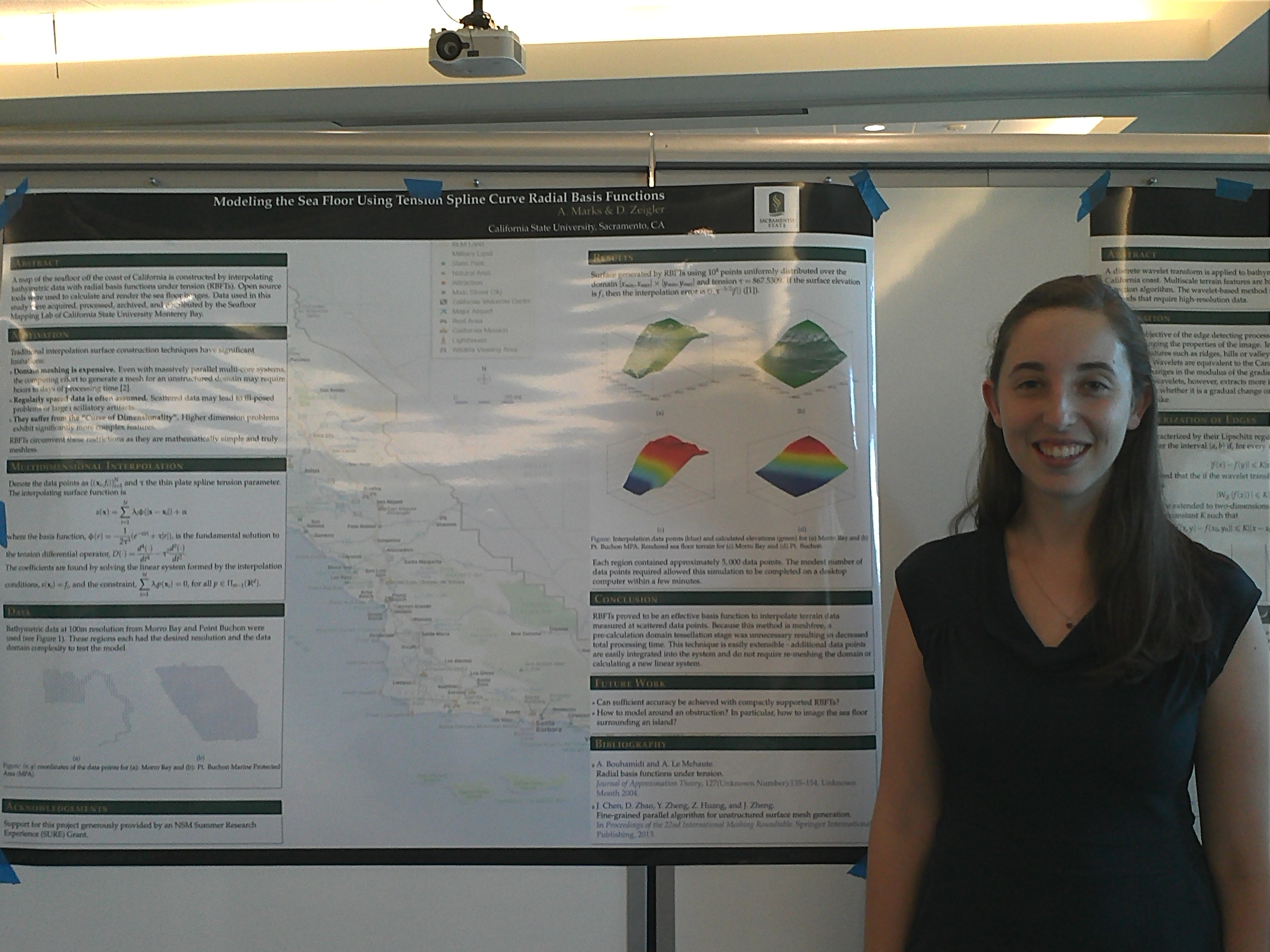 Abstract:
A map of the seafloor off the coast of California is constructed by interpolating bathymetric data with radial basis functions under tension (RBFTs).
Open source tools were used to calculate and render the sea floor images.
Data used in this study were acquired, processed, archived, and distributed by the Seafloor Mapping Lab of California State University Monterey Bay.
Abstract:
A map of the seafloor off the coast of California is constructed by interpolating bathymetric data with radial basis functions under tension (RBFTs).
Open source tools were used to calculate and render the sea floor images.
Data used in this study were acquired, processed, archived, and distributed by the Seafloor Mapping Lab of California State University Monterey Bay.
Multiresolution Edge Detection of the Sea Floor Along the California Coast (With S. Krawczyk)
Abstract: A discrete wavelet transform is applied to bathymetric data taken off the California coast. Multiscale terrain features are highlighted using an edge detection algorithm. The wavelet-based method improves upon classical methods that require high-resolution data.
Music, Math & Me: From Pythagorean Tuning to Digital Synthesis (With E. Carmi)
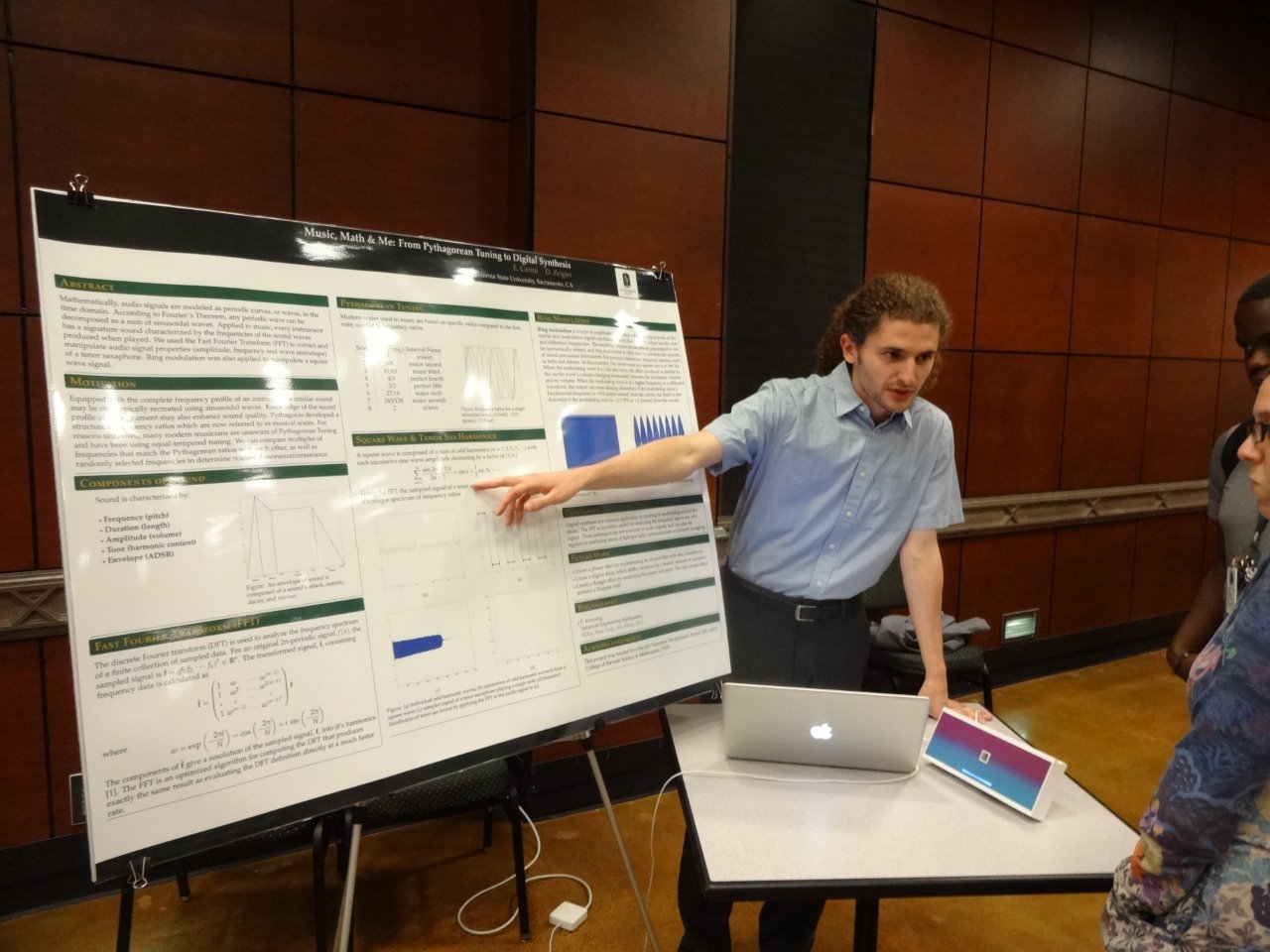 Abstract:
Mathematically, audio signals are modelled as periodic curves, or waves, in the time domain.
According to Fourier's Theorem, any periodic wave can be decomposed as a sum of sinusoidal waves.
Applied to music, every instrument has a signature sound characterized by the frequencies of the sound waves produced when played.
We used the Fast Fourier Transform (FFT) to extract and manipulate audio signal properties (amplitude, frequency and wave envelope) of a tenor saxophone.
Ring modulation was also applied to manipulate a square wave signal.
Equipped with the complete frequency profile of an instrument, a similar sound may be electronically recreated using sinusoidal waves.
Knowledge of the sound profile of an instrument may also enhance sound quality.
Pythagoras developed a structure of frequency ratios which are now referred to as musical scales.
For reasons unknown, many modern musicians are unaware of Pythagorean Tuning and have been using equal-tempered tuning.
We can compare multiples of frequencies that match the Pythagorean ratios with each other, as well as randomly selected frequencies to determine relative dissonance/consonance.
Abstract:
Mathematically, audio signals are modelled as periodic curves, or waves, in the time domain.
According to Fourier's Theorem, any periodic wave can be decomposed as a sum of sinusoidal waves.
Applied to music, every instrument has a signature sound characterized by the frequencies of the sound waves produced when played.
We used the Fast Fourier Transform (FFT) to extract and manipulate audio signal properties (amplitude, frequency and wave envelope) of a tenor saxophone.
Ring modulation was also applied to manipulate a square wave signal.
Equipped with the complete frequency profile of an instrument, a similar sound may be electronically recreated using sinusoidal waves.
Knowledge of the sound profile of an instrument may also enhance sound quality.
Pythagoras developed a structure of frequency ratios which are now referred to as musical scales.
For reasons unknown, many modern musicians are unaware of Pythagorean Tuning and have been using equal-tempered tuning.
We can compare multiples of frequencies that match the Pythagorean ratios with each other, as well as randomly selected frequencies to determine relative dissonance/consonance.
Modeling Steady-State Thermohaline Groundwater Flow Using Radial Basis Functions (With K. Smith)
Abstract: A meshless method is designed for modelling double-diffusive thermohaline groundwater flow in an aquifer. The algorithm uses the Kansa collocation method with Gaussian radial basis functions (RBFs). Numerical results are presented for the steady-state case with symmetric domain. Flows with two sources of buoyancy are of great interest with respect to contaminant transport in groundwater. However, the second source of buoyancy dramatically complicates the dynamics of heat and mass transfer. Meshless methods have shown to be an effective approach to constructing numerical simulations of the fluid flow. Using RBFs is appealing because of their high algorithmic simplicity, and independence of dimension and coordinate system. To our best knowledge, modelling double-diffusive ground water flow using Kansa's method has not been attempted.
Buoyancy-Driven Groundwater Flow as a Non-Chaotic System (With S. Krawczyck)
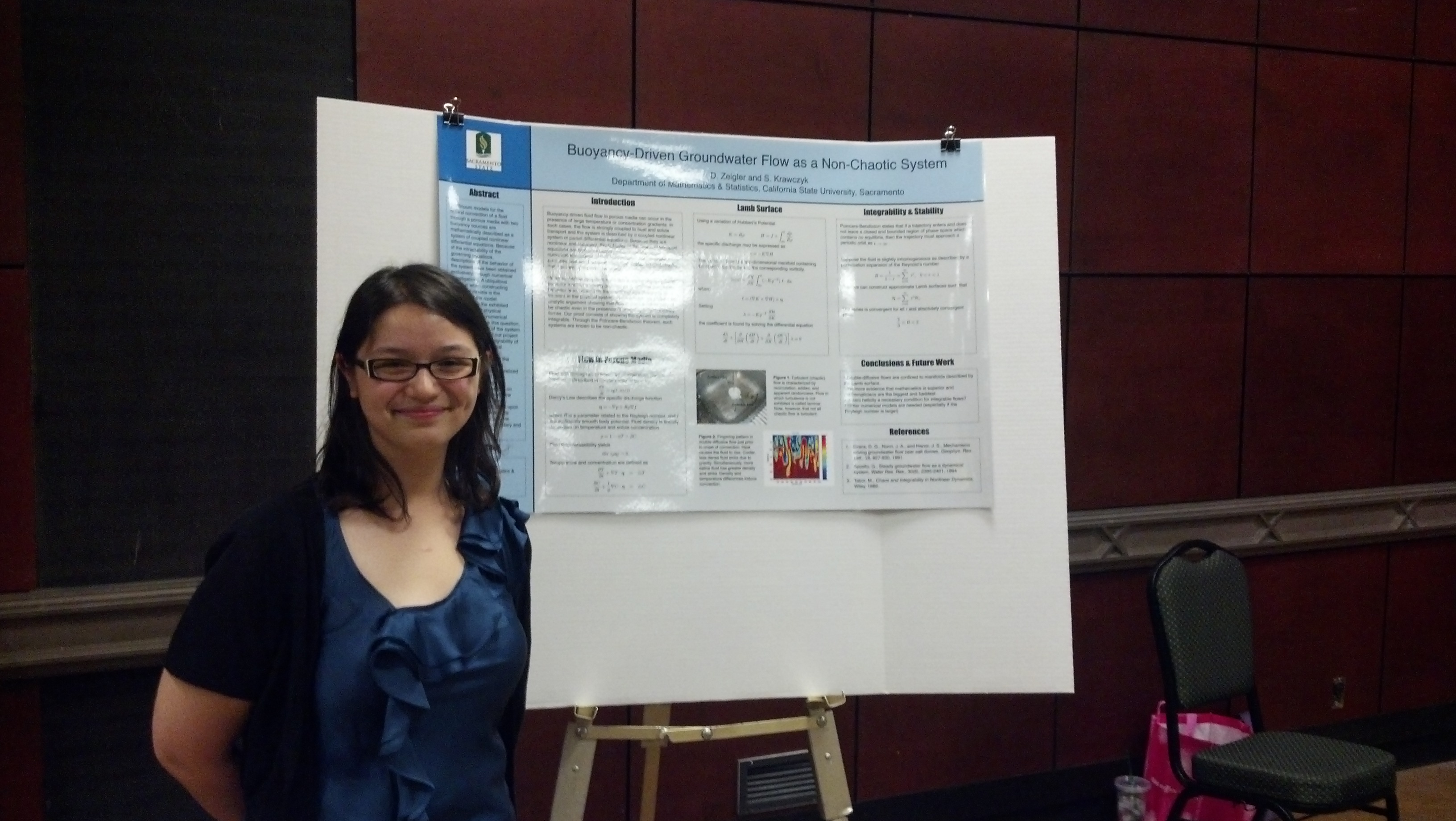 Abstract:
Continuum models for the natural convection of a fluid through a porous media with two
buoyancy sources are mathematically described as a system of coupled nonlinear differential equations.
Because of the intractability of the governing equations, descriptions of the behavior of the system have been obtained exclusively through numerical investigations.
A ubiquitous question when constructing numerical models is the accuracy of the model.
Specifically, is the exhibited behavior actual physical phenomena or a numerical artifact?
To resolve this question, a rigorous analysis of the system is required.
A goal of our project is to establish the integrability of the system of differential equations describing groundwater flow where the behavior of the system is described using the generalized Darcy Law.
This will be accomplished through the construction of a manifold on whose level surfaces all flow paths are confined.
The argument presented relies upon techniques used to analyze dynamical systems and are independent of the boundary and initial conditions.
Abstract:
Continuum models for the natural convection of a fluid through a porous media with two
buoyancy sources are mathematically described as a system of coupled nonlinear differential equations.
Because of the intractability of the governing equations, descriptions of the behavior of the system have been obtained exclusively through numerical investigations.
A ubiquitous question when constructing numerical models is the accuracy of the model.
Specifically, is the exhibited behavior actual physical phenomena or a numerical artifact?
To resolve this question, a rigorous analysis of the system is required.
A goal of our project is to establish the integrability of the system of differential equations describing groundwater flow where the behavior of the system is described using the generalized Darcy Law.
This will be accomplished through the construction of a manifold on whose level surfaces all flow paths are confined.
The argument presented relies upon techniques used to analyze dynamical systems and are independent of the boundary and initial conditions.
Cluster Formation in an Agent Based Phage-Bacterial Ecosystem (With M. Asaro)
Abstract: Bacteriophages are among the most common and diverse entities in nature. However, the investigation of many central properties of host-phage population dynamics via mathematical models is still in the nascent stages. In this paper, we will analyze the spatial properties of host-phage dynamics using an agent-based model (ABM). Each organism is represented as an agent equipped with a means for assessing and reacting to their immediate environment. Assuming virulent phage, we can show, in silico, that the bacteria and phage form "small" clusters at population equilibrium. Finally, we discuss possible extensions of the present model and scenarios for experimental testing.